
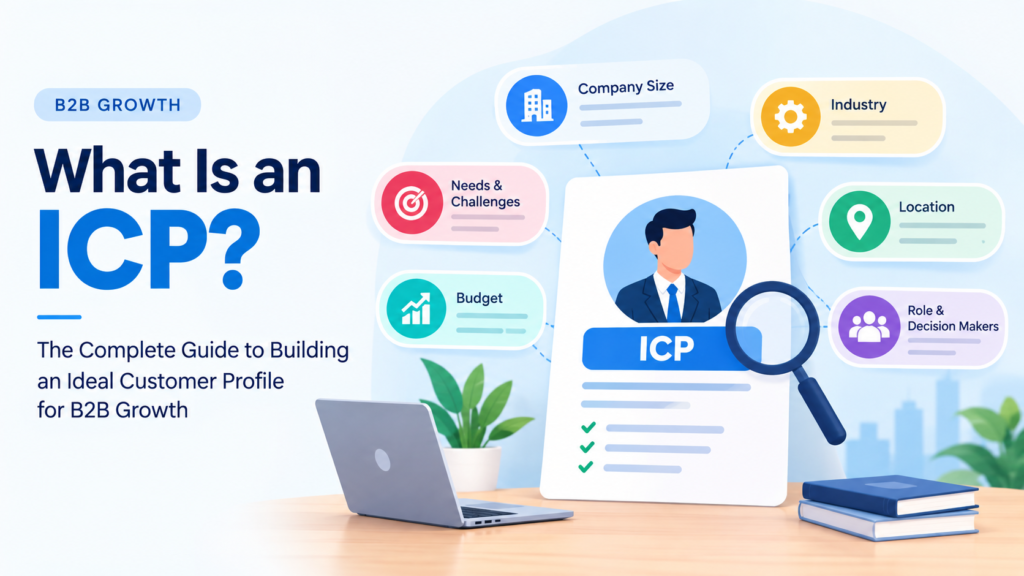
What Is an ICP? The Complete Guide to Building an Ideal Customer Profile for B2B Growth
Last updated: September 2026
Most B2B teams do not fail because they picked the wrong people to sell to. They fail because they picked the wrong companies. A brilliant salesperson can chase a perfect-sounding lead for weeks and still walk away empty-handed, simply because that lead’s company was never a fit in the first place — too small to pay, too early to care, or already locked into a competitor’s contract.
That one gap, knowing exactly which companies are worth your time, is what an Ideal Customer Profile (ICP) is built to close. This guide breaks down what an ICP is, how to build one from real data (not guesswork), and how veraciousdata.com helps B2B companies of every size build an ICP that is sharp, accurate, and genuinely their own.
Quick note before we start: This article is written for B2B (business-to-business) companies. If you sell directly to individual consumers, an ICP works differently for you, and this guide will not be the right fit.
What Is an ICP (Ideal Customer Profile)?
An ICP is a detailed, data-backed description of the type of company that gets the most value from your product, buys fastest, stays the longest, and grows into your best account over time. It is not a wish list. It is a working definition, built from evidence, that tells your sales and marketing teams exactly who to chase and, just as importantly, who to walk away from.
An ICP typically combines three layers of information:
- Firmographic data — industry, company size, revenue, headcount, location, and growth stage.
- Technographic data — the tools and tech stack a company already uses.
- Behavioral and situational signals — hiring patterns, funding events, compliance deadlines, or other triggers that show a company is ready to buy right now.
ICP vs. Buyer Persona: What’s the Difference?
This is one of the most common mix-ups in B2B marketing, so let’s clear it up simply:
- An ICP describes the company — “Should we even be talking to this business?”
- A buyer persona describes the person — “Who inside that business do we need to talk to?”
You need both. The ICP tells you which doors to knock on. The persona tells you who to ask for once you’re inside.
Why an ICP Matters More Than Ever
Here’s a number worth sitting with: research on B2B go-to-market strategy shows that a majority of B2B companies still have not clearly defined their ICP, and the ones that do report meaningfully higher win rates than those that don’t, according to 2026 B2B go-to-market research from Landbase. That gap is not small, and it is not random. It is the direct, measurable cost of selling to everyone instead of selling to the right ones.
The most important point: An ICP is not a marketing document that sits in a slide deck and gathers dust. It is a living, working filter that should guide who your sales team calls, who your ads target, what your product roadmap prioritizes, and which leads your marketing team even bothers nurturing.
How to Build a List of ICPs: A Step-by-Step Framework
Building an ICP is not about imagining your “dream customer.” It’s about looking honestly at the customers you already have and asking which ones are actually working out well for you. Here is a practical, proven path.
Step 1: Start With Your Best Existing Customers
Pull your closed-won accounts from your CRM and rank them by what actually matters: retention, deal size, time-to-close, expansion revenue, and support cost. Your dream logos are not data. Your renewals are.
Step 2: Layer In Firmographic Data
For each top account, record the shared firmographic traits: industry, employee count, annual revenue, funding stage, geography, and company age. Patterns will start to appear almost immediately, and those patterns are gold.
Step 3: Add Technographic Signals
Firmographics tell you who a company is. Technographics tell you whether they’re ready. A company already running modern tools in your category is a warmer prospect than one still building that infrastructure from scratch.
Step 4: Identify Behavioral and Situational Triggers
What was happening at these companies right before they bought? A new VP hire? A funding round? A compliance deadline? These “buying triggers” are often more predictive than any firmographic detail alone.
Step 5: Write the Disqualification List
This step gets skipped constantly, and it shouldn’t. Knowing who not to chase is just as valuable as knowing who to pursue. Most churned or stalled deals fit the demographic profile but never had a real trigger to buy.
Step 6: Test the List Against Your Total Market
Run your criteria against your full addressable market. If it produces a workable, sizeable list of accounts, you have a usable ICP. If it produces only a handful of companies, your filters are too narrow, and it’s time to loosen one variable at a time until the numbers make sense again.
Step 7: Score, Tier, and Refresh
Assign a simple point score to each account based on ICP fit, then group them into tiers (for example, Tier 1 for immediate outreach, Tier 2 for secondary campaigns). Revisit the whole model every three to six months. Markets shift, products evolve, and a static ICP quietly becomes a stale one.
How an ICP Helps a Startup
For an early-stage company, every single sales hour is precious, and there is rarely a big team to absorb wasted effort. An ICP gives a startup something it desperately needs in the early days: focus.
- Faster product-market fit signals. A tight ICP helps a startup notice, quickly, which type of company is actually getting value from the product, rather than spreading thin across a dozen unrelated segments.
- Smarter use of limited budget. Every advertising dollar and outbound email goes further when it’s aimed at companies who were always going to say yes.
- Cleaner investor conversations. A defined ICP shows investors that the founding team understands its market, not just its product.
- A foundation that scales. The ICP a startup builds in year one becomes the backbone that sales, marketing, and even the product roadmap build on for years to come.
How an ICP Helps a Medium-Sized Business
A medium-sized B2B company usually has an established customer base already, but growth starts to plateau because the sales team is chasing too many different kinds of accounts at once. This is exactly where an ICP earns its keep.
- Aligns sales and marketing. When both teams work from the same ICP definition, lead quality goes up and the constant “these leads aren’t good enough” friction disappears.
- Improves lead scoring and routing. ICP-fit accounts can skip generic nurture sequences and go straight to a live sales conversation, speeding up the pipeline.
- Sharpens expansion strategy. A mid-market business can use its ICP to identify adjacent segments worth testing next, instead of guessing at new markets.
- Protects margins. By disqualifying poor-fit leads early, teams stop burning hours on deals that were never going to close profitably.
How an ICP Helps an Enterprise
For a large enterprise, the challenge is different: the addressable market is huge, sales cycles are long, and dozens of stakeholders may touch a single deal. An ICP at this scale becomes an operational system, not just a document.
- Powers account-based marketing (ABM) at scale. Enterprises can build precision target-account lists instead of broad, expensive campaigns aimed at “everyone in an industry.”
- Guides territory and resource planning. Sales leadership can allocate reps, budget, and specialized teams toward the highest-value segments identified by the ICP.
- Feeds AI and automation tools. Enterprise revenue teams increasingly plug ICP data directly into AI agents and lead-scoring systems that reason across CRM, intent, and firmographic data, a trend ZoomInfo has documented as more revenue teams connect enriched account data straight into their AI-driven workflows.
- Reduces churn and improves retention. By validating the ICP against renewal and expansion data (not just first-sale data), enterprises catch which “logos” are genuinely profitable long-term versus which ones quietly drain support resources.
How Long Does It Take to Build an ICP?
This is one of the most common questions we hear, and the honest answer is: it depends on your data maturity, but here is a realistic breakdown most B2B teams can expect:
| Business Stage | Typical Time to Build a First ICP | What Drives the Timeline |
|---|---|---|
| Startup (limited customer data) | 1 to 2 weeks | Small customer base means less data to analyze, but more assumptions need validating |
| Medium business (established CRM data) | 2 to 4 weeks | More historical data to mine, plus alignment meetings between sales and marketing |
| Enterprise (multiple product lines, regions) | 4 to 8+ weeks | Complexity of stakeholders, data sources, and regional or product-line variations |
A good ICP is never truly “done.” Most B2B teams treat the first build as a milestone, then revisit and refresh it every six to twelve months, or immediately after a major product change or new market entry.
How veraciousdata.com Helps You Build a Focused, Customized ICP
Generic ICP templates are a starting point, not a solution. Every business has a different customer base, a different sales cycle, and a different definition of a “good” account. This is exactly the gap veraciousdata.com is built to close.
Here’s how we work with B2B companies to build an ICP that actually reflects their business:
- We start with your real data, not assumptions. We pull and analyze your closed-won accounts, renewals, and expansion data to find the true patterns behind your best customers.
- We layer in firmographic and technographic enrichment. Your ICP is built on verified company data, not guesswork or outdated spreadsheets.
- We customize for your growth stage. A startup’s ICP, a medium-sized business’s ICP, and an enterprise’s ICP need very different levels of detail and different data sources. We build accordingly.
- We validate before we deliver. Every ICP we build is tested against your addressable market to confirm it’s neither too narrow to be useful nor too broad to be meaningful.
- We keep it alive. An ICP that isn’t refreshed goes stale fast. We help set up a simple review cadence so your ICP evolves as your business does.
The result is a focused, testable, one-page ICP your sales and marketing teams can genuinely use, not a slide that gets opened once and forgotten.
Key Takeaways
- An ICP describes the company, not the individual buyer — that’s the job of a buyer persona.
- Build your ICP from real closed-won and renewal data, never from a wish list.
- Firmographic, technographic, and behavioral signals together make an ICP accurate and testable.
- A startup uses an ICP for focus and faster product-market fit. A medium-sized business uses it to align sales and marketing and scale efficiently. An enterprise uses it to power ABM, resource planning, and AI-driven targeting at scale.
- Building a first ICP typically takes one to eight weeks, depending on company size and data maturity, and should be refreshed every six to twelve months.
- veraciousdata.com builds ICPs that are customized to your actual business, not copy-pasted from a generic template.
Frequently Asked Questions
What does ICP stand for in B2B sales?
ICP stands for Ideal Customer Profile — a description of the type of company most likely to buy, succeed with, and stay loyal to your product, as Salesforce’s own definition of the term puts it.
Is an ICP the same as a target market?
Not quite. A target market is broad (an industry or region), while an ICP is a precise, testable filter within that market built from real customer data.
How often should a company update its ICP?
Most B2B teams review their ICP every six to twelve months, or sooner if the product, pricing, or market shifts significantly.
Can a company have more than one ICP?
Yes. Many B2B companies, especially those with multiple products or serving both mid-market and enterprise buyers, maintain two or three distinct ICPs rather than forcing one definition to cover everyone.